Chernobyl Man Living the Good Life
One man is thriving in a part of the world deemed unsafe for human population.
Vyshhorod Raion, Ukraine – Nearly 40 years after the Chernobyl disaster, the exclusion zone has become one of the strangest wildlife success stories on planet Earth. While radiation levels remain a serious concern in parts of the region, just four decades without subdivisions, shopping centers, logging, or heavy human activity have allowed wolves, lynxes, moose, deer, wild boar, beavers, and countless other species to reclaim the landscape. Scientists continue to study the long-term effects of radiation on individual animals, but one thing is hard to ignore: when people left, nature got busy.
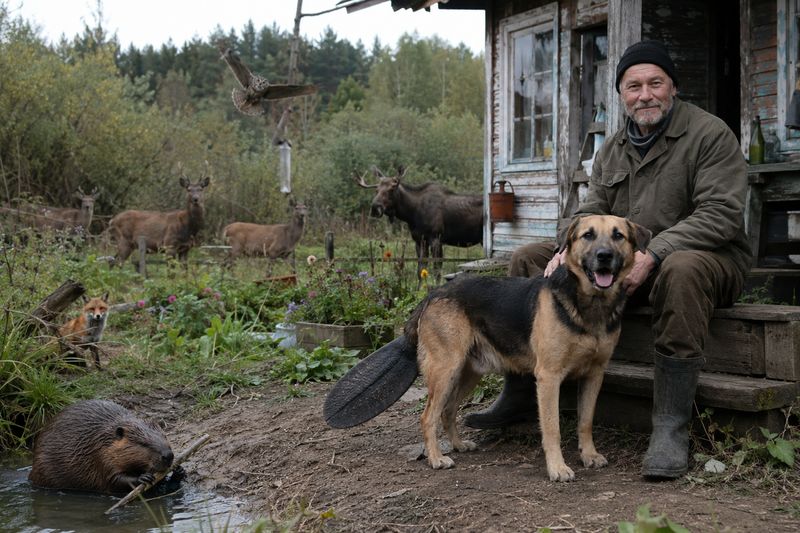
Ivan Petrov doesn't spend much time worrying about property values. His morning commute is roughly twelve steps from the front porch to the woodpile, where he's usually greeted by Boris—a loyal, questionably symmetrical dog whose tail seems to be mysteriously suited for aquatic navigation. The coffee goes on the stove. Boris trots off to investigate fresh deer tracks. Somewhere beyond the tree line, wolves announce the sunrise with a chorus that beats any alarm clock ever manufactured. By lunch, the deer have sampled Ivan's tomatoes, a family of wild boar has enthusiastically remodeled the front yard, and a pair of curious foxes has inspected the chicken coop like tiny health inspectors with excellent hearing. His nearest neighbors are miles away. Nobody is firing up a leaf blower at 7 a.m. Nobody is debating fence heights. Nobody has posted multiple passive-aggressive messages about recycling bins. The loudest thing in the neighborhood is nature going about its business. Would Ivan recommend living next to the site of history's worst nuclear disaster? Probably not. But after four decades of watching forests reclaim abandoned roads and wildlife return to places once dominated by people, he has developed a theory. Maybe the greatest luxury isn't having more room for ourselves. Maybe it's finally giving the rest of the planet some room of its own. Judging by the exclusion zone, nature doesn't seem to hold a grudge. It just asks to be left alone... and then quietly gets back to work.
Ivan Petrov doesn't spend much time worrying about property values. His morning commute is roughly twelve steps from the front porch to the woodpile, where he's usually greeted by Boris—a loyal, questionably symmetrical dog whose tail seems to be mysteriously suited for aquatic navigation. The coffee goes on the stove. Boris trots off to investigate fresh deer tracks. Somewhere beyond the tree line, wolves announce the sunrise with a chorus that beats any alarm clock ever manufactured. By lunch, the deer have sampled Ivan's tomatoes, a family of wild boar has enthusiastically remodeled the front yard, and a pair of curious foxes has inspected the chicken coop like tiny health inspectors with excellent hearing. His nearest neighbors are miles away. Nobody is firing up a leaf blower at 7 a.m. Nobody is debating fence heights. Nobody has posted multiple passive-aggressive messages about recycling bins. The loudest thing in the neighborhood is nature going about its business. Would Ivan recommend living next to the site of history's worst nuclear disaster? Probably not. But after four decades of watching forests reclaim abandoned roads and wildlife return to places once dominated by people, he has developed a theory. Maybe the greatest luxury isn't having more room for ourselves. Maybe it's finally giving the rest of the planet some room of its own. Judging by the exclusion zone, nature doesn't seem to hold a grudge. It just asks to be left alone... and then quietly gets back to work.