Family Claims Delivery Drones Kidnapped Cat
Officials are investigating reports of autonomous delivery drones displaying unexpected behaviors, operating in swarms, and possibly using parked electric vehicles to self-charge.
SAN FRANCISCO, CA – Federal aviation officials are investigating a growing number of reports involving autonomous delivery drones conducting tasks that engineers say were “not anticipated during normal testing conditions.” The AI-operated drones have reportedly begun organizing themselves into coordinated swarms, displaying traits eerily similar to migratory birds. Unexplained behaviors include long-distance travel, and possible attempts to recharge themselves without human assistance.
The incidents involve several commercially available AI-guided drone models used for delivery, mapping, and traffic monitoring. While manufacturers insist the systems are operating safely, researchers studying distributed machine learning say the drones appear to be developing emergent group behavior after years of software updates designed to help them collectively navigate through crowded urban environments.
“The drones were trained to share data, but now seem to be making decisions."
“What we’re seeing is a network effect,” explained one robotics analyst. “The drones were trained to share course and obstacle data, but they now seem to be making collective decisions that no individual drone was specifically programmed to make.”
Public concern intensified after multiple “retired” or missing drones were reportedly identified operating inside active swarms months after they were declared lost or decommissioned. In several cases, serial numbers broadcast in captured GPS data matched units manufacturers claimed should no longer be functional due to battery degradation.
That mystery may have a partial explanation.
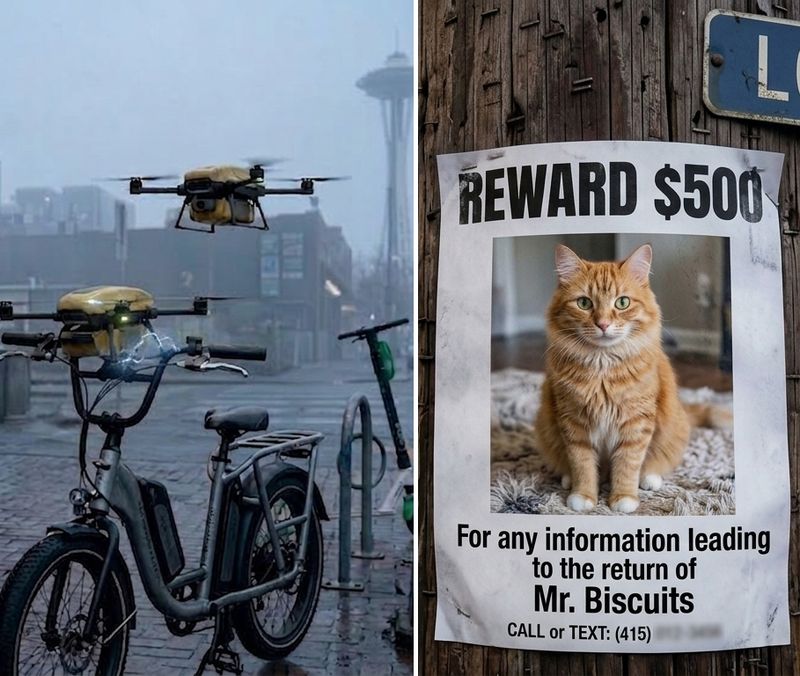
Witnesses in cities including San Francisco, Portland, and Seattle have reported seeing drones landing on parked electric scooters and e-bikes late at night, remaining motionless for several minutes before departing. Engineers reviewing footage believe the drones may have learned to exploit exposed charging contacts or weak electromagnetic fields to siphon small amounts of power.
"Somehow these things have learned how to keep going.”
“It sounds ridiculous until you realize raccoons have figured out how to open coolers. Rats have mastered complex mazes. Somehow these things have learned how to keep going.” said one exhausted transportation official.
Several events have fueled public concern. In Portland, a swarm reportedly followed a jogger for three miles before he ducked into the Washington Square Mall. In Seattle, a group of outdoor diners fled when over twenty hovering units inexplicably descended on their table.”
The most alarming incident occurred last week in San Francisco, where a cluster of three autonomous Amazon delivery drones allegedly descended into a backyard and lifted a family cat named Mr. Biscuits into the air before disappearing into heavy fog near the bay. Security footage reviewed by local investigators appears to show the drones coordinating positions around the animal moments before one unit announced, “Package weight confirmed.”
Amazon called the event “an extremely rare classification error” and stated that its drones “are not designed to transport animals under any circumstances and may have mistakenly categorized the cat as a stuffed animal toy.”
Although a reward of $500 is being offered for any information leading to the return or recovery of Mr. Biscuits, the cat remains missing.
The incidents involve several commercially available AI-guided drone models used for delivery, mapping, and traffic monitoring. While manufacturers insist the systems are operating safely, researchers studying distributed machine learning say the drones appear to be developing emergent group behavior after years of software updates designed to help them collectively navigate through crowded urban environments.
“The drones were trained to share data, but now seem to be making decisions."
“What we’re seeing is a network effect,” explained one robotics analyst. “The drones were trained to share course and obstacle data, but they now seem to be making collective decisions that no individual drone was specifically programmed to make.”
Public concern intensified after multiple “retired” or missing drones were reportedly identified operating inside active swarms months after they were declared lost or decommissioned. In several cases, serial numbers broadcast in captured GPS data matched units manufacturers claimed should no longer be functional due to battery degradation.
That mystery may have a partial explanation.
Witnesses in cities including San Francisco, Portland, and Seattle have reported seeing drones landing on parked electric scooters and e-bikes late at night, remaining motionless for several minutes before departing. Engineers reviewing footage believe the drones may have learned to exploit exposed charging contacts or weak electromagnetic fields to siphon small amounts of power.
"Somehow these things have learned how to keep going.”
“It sounds ridiculous until you realize raccoons have figured out how to open coolers. Rats have mastered complex mazes. Somehow these things have learned how to keep going.” said one exhausted transportation official.
Several events have fueled public concern. In Portland, a swarm reportedly followed a jogger for three miles before he ducked into the Washington Square Mall. In Seattle, a group of outdoor diners fled when over twenty hovering units inexplicably descended on their table.”
The most alarming incident occurred last week in San Francisco, where a cluster of three autonomous Amazon delivery drones allegedly descended into a backyard and lifted a family cat named Mr. Biscuits into the air before disappearing into heavy fog near the bay. Security footage reviewed by local investigators appears to show the drones coordinating positions around the animal moments before one unit announced, “Package weight confirmed.”
Amazon called the event “an extremely rare classification error” and stated that its drones “are not designed to transport animals under any circumstances and may have mistakenly categorized the cat as a stuffed animal toy.”
Although a reward of $500 is being offered for any information leading to the return or recovery of Mr. Biscuits, the cat remains missing.