Breaking: Humanity Discovers It Owes Itself $350 Trillion

A global audit of $350 trillion in debt has revealed a shocking truth: humanity owes itself an extraordinary amount of money.
Geneva, Switzerland -- For years, economists have warned that global debt has reached alarming levels. Recent estimates put the number somewhere around $350 trillion, a figure so large it can only be properly understood when written in scientific notation or whispered slowly into a microphone during a financial crisis.
Concerned by the size of the number, a coalition of global economists recently attempted the most ambitious accounting exercise in human history: figuring out who exactly all this money is owed to. What they discovered has shaken the financial world.
"Who exactly all this money is owed to?"
After several months of tracing loans, bonds, mortgages, and complex financial instruments through banks, governments, corporations, and pension funds, researchers arrived at a stunning conclusion: Everyone owes everyone else.
A mortgage owed to a bank turns out to be an asset backing a pension fund. The pension fund is invested in government bonds. The government bonds are financed by taxes collected from citizens who took out mortgages from the same banks that hold the bonds.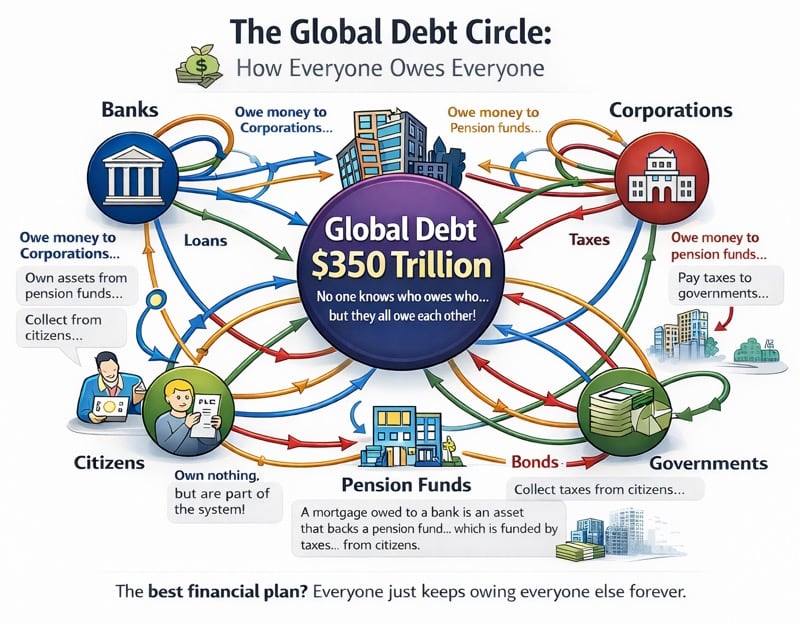 In other words, the global financial system appears to function as a highly sophisticated circle.
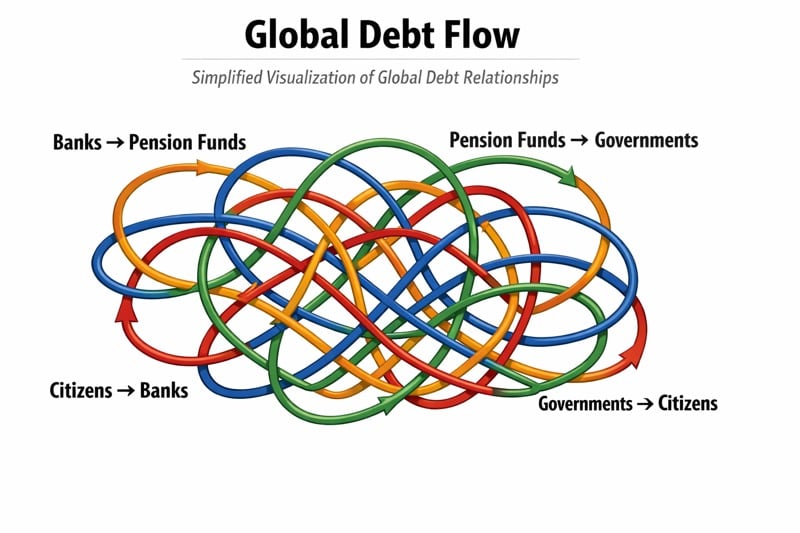
“It’s actually quite elegant,” said one economist, gesturing vaguely at a chart that resembled a bowl of spaghetti. “If everyone simply pays off their debts, the entire system disappears.” This revelation has alarmed policymakers, who worry the public may misunderstand the situation and attempt something reckless like being financially responsible. “We want to be very clear,” officials said in a statement. “Paying off all debts at once could destabilize the global economy by removing the assets that currently exist because of those debts.”
In other words, the global financial system appears to function as a highly sophisticated circle.
“It’s actually quite elegant,” said one economist, gesturing vaguely at a chart that resembled a bowl of spaghetti. “If everyone simply pays off their debts, the entire system disappears.” This revelation has alarmed policymakers, who worry the public may misunderstand the situation and attempt something reckless like being financially responsible. “We want to be very clear,” officials said in a statement. “Paying off all debts at once could destabilize the global economy by removing the assets that currently exist because of those debts.”
 Experts explained that debt performs a crucial role in modern finance by existing.
“Imagine a world where nobody owed anyone anything,” said one analyst. “Banks would have nothing to collect. Investors would have nothing to hold. Entire buildings full of people who move numbers between spreadsheets would simply vanish.”
Experts explained that debt performs a crucial role in modern finance by existing.
“Imagine a world where nobody owed anyone anything,” said one analyst. “Banks would have nothing to collect. Investors would have nothing to hold. Entire buildings full of people who move numbers between spreadsheets would simply vanish.”
The report also confirmed another surprising detail: if every loan were repaid tomorrow, the financial system would experience a catastrophic shortage of assets. Markets would plummet as trillions of dollars’ worth of financial instruments quietly evaporated. “This is why stability is so important,” one official noted. “We need people to continue owing each other money in a calm and orderly fashion.”
“We need people to continue owing each other money"
Despite the alarming headline figures, economists insist there is no cause for panic. The global financial system has been functioning this way for decades and has proven remarkably resilient. For now, leaders say the best course of action is simple. Everyone should continue making payments to everyone else indefinitely.
In a rare moment of worldwide consensus, humanity appears to have agreed on the safest possible economic arrangement: a system in which no one actually settles the tab.
Concerned by the size of the number, a coalition of global economists recently attempted the most ambitious accounting exercise in human history: figuring out who exactly all this money is owed to. What they discovered has shaken the financial world.
"Who exactly all this money is owed to?"
After several months of tracing loans, bonds, mortgages, and complex financial instruments through banks, governments, corporations, and pension funds, researchers arrived at a stunning conclusion: Everyone owes everyone else.
A mortgage owed to a bank turns out to be an asset backing a pension fund. The pension fund is invested in government bonds. The government bonds are financed by taxes collected from citizens who took out mortgages from the same banks that hold the bonds.
In other words, the global financial system appears to function as a highly sophisticated circle.
“It’s actually quite elegant,” said one economist, gesturing vaguely at a chart that resembled a bowl of spaghetti. “If everyone simply pays off their debts, the entire system disappears.” This revelation has alarmed policymakers, who worry the public may misunderstand the situation and attempt something reckless like being financially responsible. “We want to be very clear,” officials said in a statement. “Paying off all debts at once could destabilize the global economy by removing the assets that currently exist because of those debts.”
Experts explained that debt performs a crucial role in modern finance by existing.
“Imagine a world where nobody owed anyone anything,” said one analyst. “Banks would have nothing to collect. Investors would have nothing to hold. Entire buildings full of people who move numbers between spreadsheets would simply vanish.”
The report also confirmed another surprising detail: if every loan were repaid tomorrow, the financial system would experience a catastrophic shortage of assets. Markets would plummet as trillions of dollars’ worth of financial instruments quietly evaporated. “This is why stability is so important,” one official noted. “We need people to continue owing each other money in a calm and orderly fashion.”
“We need people to continue owing each other money"
Despite the alarming headline figures, economists insist there is no cause for panic. The global financial system has been functioning this way for decades and has proven remarkably resilient. For now, leaders say the best course of action is simple. Everyone should continue making payments to everyone else indefinitely.
In a rare moment of worldwide consensus, humanity appears to have agreed on the safest possible economic arrangement: a system in which no one actually settles the tab.