AI Servers Blamed for Regional Drought as Experimental Cooling Method Raises New Questions
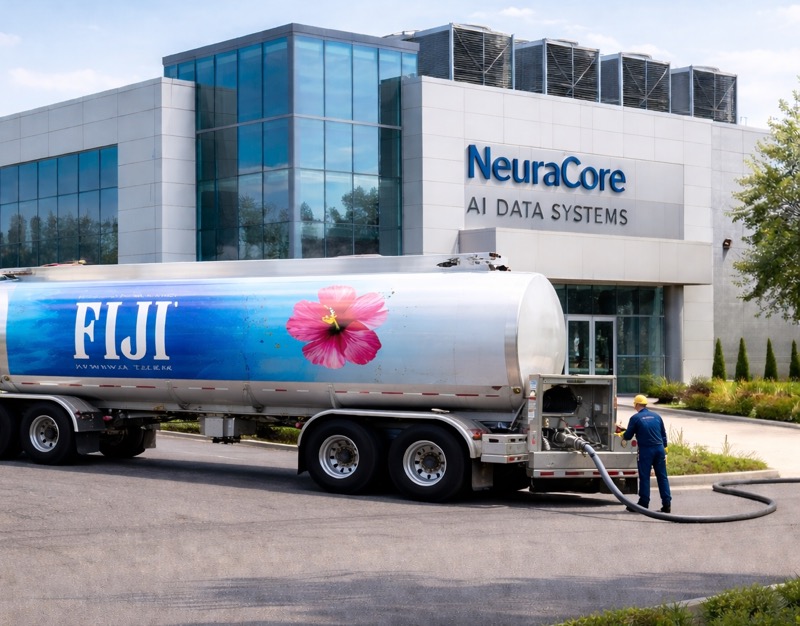
Engineers have improved AI performance. The solution was high-quality bottled water.
SILICON VALLEY — Concerns over water shortages escalated this week after multiple reports suggested that large - scale A.I. data centers may be contributing to regional drought conditions, as demand for cooling infrastructure continues to rise alongside rapid advancements in artificial intelligence.
It is well established that modern A.I. data centers require significant cooling systems — many of these centers rely heavily on water — to prevent overheating. But according to industry insiders, a recent experiment aimed at improving system performance may be complicating the issue.
The Experiment
“It started as a controlled test,” said one engineer familiar with the project. “We wanted to see if variations in water quality had any measurable effect on cooling efficiency. No one expected… this.” During the experiment, engineers replaced standard cooling inputs with small quantities of premium bottled water, including Fiji Water, to evaluate potential differences in system stability.
“We observed faster processing speeds, fewer errors, and a noticeable increase in output confidence,” the engineer said. “At one point the model stopped hedging entirely. It just gave answers. Boldly.” Follow-up testing appeared to confirm a performance gap between water sources. Advanced AI systems consistently demonstrated peak efficiency when cooled with higher-end bottled water, while attempts to revert to municipal sources resulted in what researchers described as “a return to more cautious, slightly uncertain behavior.”
Mid-tier systems, however, proved less sensitive. Many continued operating effectively with widely available options such as Deer Park, with only minor dips in what internal reports labeled “decisiveness metrics.” Lower-tier or older models showed virtually no change regardless of input.
“They’re fine,” one technician said. “You can run those things on Deer Park, hose water, whatever’s nearby. They’re not trying to be heroes—they just show up and do the job.”
The Results
The findings have sparked internal debate across the tech industry, particularly as companies face increasing scrutiny over water usage in drought-prone areas. While most firms have publicly downplayed the significance of the experiment, sources indicate that some facilities have already begun quietly incorporating higher-quality water into select cooling systems.
“Our infrastructure does not require premium inputs,” a company spokesperson said in a statement. “However, we remain committed to optimizing performance wherever meaningful gains are identified.” Privately, however, engineers admit the shift may be difficult to reverse. “Once you’ve seen what these systems can do at full capacity, it’s hard to go back,” one source said. “It’s like unlocking a higher version of the same model.”
Conclusion
Experts now agree that peak performance-whether human or artificial-may come down to the same thing: optimal conditions, premium quality water, and a vague sense of superiority to function at their best.
It is well established that modern A.I. data centers require significant cooling systems — many of these centers rely heavily on water — to prevent overheating. But according to industry insiders, a recent experiment aimed at improving system performance may be complicating the issue.
The Experiment
“It started as a controlled test,” said one engineer familiar with the project. “We wanted to see if variations in water quality had any measurable effect on cooling efficiency. No one expected… this.” During the experiment, engineers replaced standard cooling inputs with small quantities of premium bottled water, including Fiji Water, to evaluate potential differences in system stability.
“We observed faster processing speeds, fewer errors, and a noticeable increase in output confidence,” the engineer said. “At one point the model stopped hedging entirely. It just gave answers. Boldly.” Follow-up testing appeared to confirm a performance gap between water sources. Advanced AI systems consistently demonstrated peak efficiency when cooled with higher-end bottled water, while attempts to revert to municipal sources resulted in what researchers described as “a return to more cautious, slightly uncertain behavior.”
Mid-tier systems, however, proved less sensitive. Many continued operating effectively with widely available options such as Deer Park, with only minor dips in what internal reports labeled “decisiveness metrics.” Lower-tier or older models showed virtually no change regardless of input.
“They’re fine,” one technician said. “You can run those things on Deer Park, hose water, whatever’s nearby. They’re not trying to be heroes—they just show up and do the job.”
The Results
The findings have sparked internal debate across the tech industry, particularly as companies face increasing scrutiny over water usage in drought-prone areas. While most firms have publicly downplayed the significance of the experiment, sources indicate that some facilities have already begun quietly incorporating higher-quality water into select cooling systems.
“Our infrastructure does not require premium inputs,” a company spokesperson said in a statement. “However, we remain committed to optimizing performance wherever meaningful gains are identified.” Privately, however, engineers admit the shift may be difficult to reverse. “Once you’ve seen what these systems can do at full capacity, it’s hard to go back,” one source said. “It’s like unlocking a higher version of the same model.”
Conclusion
Experts now agree that peak performance-whether human or artificial-may come down to the same thing: optimal conditions, premium quality water, and a vague sense of superiority to function at their best.